
By Expressões Anarquistas – Fenikso Nigra
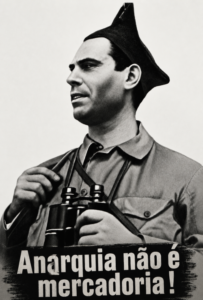
There’s a misconception that repeats itself, year after year, book fair after book fair: the idea that it’s enough to stack black and red books on a table, sell t-shirts with the circled “A,” profit from raised-fist stickers, for anarchy to be there, present, materialized. But anarchy doesn’t fit on a shelf. It has no barcode.
Capitalism is voracious. It devours everything it touches, including — and especially — that which was born to negate it. It turns revolt into a print pattern, turns critique into a niche item, turns rupture into a trend. And so, paradoxically, what should be the radical negation of commodity logic becomes just another commodity: the “revolutionary product,” sold to an audience that consumes the aesthetics of rebellion without touching its substance.
But being a hostage of capitalism — living inside it, needing it to survive, to buy food, pay rent, sell one’s own labor power — is not the same as accepting that everything, including the ideas that fight this system, must submit to its logic. Existing inside the cage doesn’t obligate anyone to decorate the bars.
Anarchy, when genuine, is practice before it is product. It’s horizontal organization, it’s mutual aid, it’s refusal of hierarchy, it’s collective construction of other ways of living and deciding. It happens in assemblies, in occupations, in collectives that divide tasks without a boss, in care networks that expect no profit. It doesn’t need a price tag to exist — in fact, the price tag is exactly what empties it out.
Selling books about anarchism isn’t the problem in itself — knowledge needs to circulate, and those who write, translate, lay out, and print also need to eat. The problem is when market logic becomes the center, when the gesture of resistance is replaced by the gesture of consumption, when buying the book gets confused with living the idea, when the aesthetic of the “revolutionary” becomes a seal of subcultural authenticity, competing for space and symbolic capital like any other brand on the market.
A book fair can be a space of encounter, of formation, of organization — or it can be just another fair, an alternative shopping mall, where the novelty is the packaging, not the content. The difference isn’t in the fact that money is circulating (it always will, as long as we live under this system), but in where that money goes, who decides, what gets built with it, and whether the space follows a different logic of relation — without a stage-and-audience hierarchy, without spectacle, without stardom.
Anarchy is not a character, not a logo, not a hashtag. It’s everyday practice, it’s risk assumed, it’s the concrete refusal to command and to obey. It can be read in books, but it’s only confirmed in actions. And no action is truly sold on a shelf or at a fair table, promoting some academic anarchologist or another.