
Basic Dossier — Power, Domination, and Resistance
By Akracia – Fenikso Nigra
Introduction
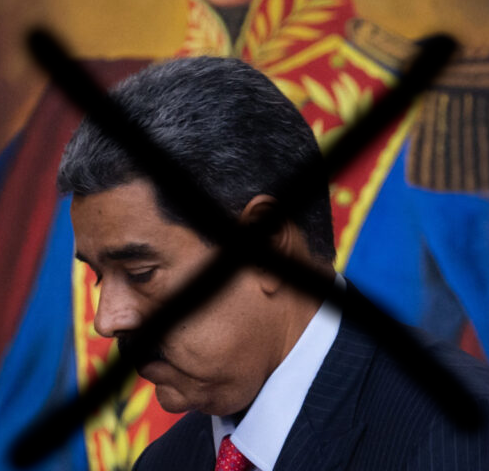
The capture of Nicolás Maduro by United States forces in a military operation carried out on Venezuelan territory was quickly interpreted by governments, media, and analysts as the culmination of an authoritarian cycle. For an anarchist reading, however, the episode does not represent a historical rupture, but the continuation of domination by other means.
This short dossier starts from a central rejection: the idea that freedom can be produced by states, whether through the permanence of an authoritarian/totalitarian regime or through the intervention of a foreign power. The Venezuelan case reveals, in a concentrated way, the structural limits of state politics and the international order based on force.
The Collapse of Legitimacy and the Persistence of the State
The government of Nicolás Maduro has consolidated itself as an authoritarian regime sustained by political repression, institutional control, and widely questioned electoral processes. The international disapproval of the last elections is not a mere diplomatic detail, but a symptom of the erosion of state legitimacy. However, anarchist criticism is not limited to the degeneration of a specific government. The central problem lies in the State as a political form: a structure that monopolizes violence, separates rulers and ruled, and perpetuates itself even when it loses any real connection with society.
In Venezuela, the collapse of legitimacy did not lead to the dissolution of the State, but to its hardening. The response to the crisis was more control, more repression, and more distance between power and the population—a dynamic common to regimes in decline.
Imperial Intervention as a Systemic Logic
The intervention of the United States is neither a moral exception nor a humanitarian gesture. It is a recurring practice of hegemonic states that claim for themselves the right to decide the political destiny of other territories.
Under the discourse of democracy and stability, the same logic that has historically sustained coups, occupations, and political tutelage operates: the replacement of a ruling elite with one more functional to the dominant geopolitical interests.
From an anarchist point of view, there is no contradiction between internal authoritarianism and external intervention. Both are complementary expressions of an international system based on coercion, hierarchy, and the denial of social self-determination.
International Law: Normalization of State Violence
The violation of Venezuelan sovereignty reveals less a “crisis” of international law and more its real function. The norms that regulate the use of force operate selectively, subordinated to the correlation of power between states.
International law does not prevent state violence; it administers it. When a peripheral state transgresses, it is punished. When a power intervenes, a subsequent legal justification is constructed.
For anarchism, this selectivity is not a deviation, but a structural characteristic of a system that never aimed to protect populations, but rather to organize domination between states.
The Venezuelan people as an object of politics
The systematically silenced element is Venezuelan society. After years of impoverishment, forced migration, and repression, the population now faces a transition conducted without its effective participation.
The removal of Maduro was not the result of autonomous popular organization, but of an external military decision. This keeps the people in the same political place: outside the decision-making process, called upon only to legitimize accomplished facts.
History demonstrates that imposed transitions tend to preserve economic structures and power relations, even under new administrations. The State changes hands; domination remains.
The false dilemma: dictatorship or empire
Geopolitics imposes an artificial dilemma: accept an internal authoritarian regime or support external intervention. This formulation eliminates the possibility of alternatives based on autonomy, self-management, and horizontal organization.
The anarchist tradition rejects this framework. There is no possible emancipation within a choice between States. Freedom does not emerge from the replacement of rulers, but from the dissolution of the relations that allow governance.
As long as politics remains concentrated in state institutions, any “democratic transition” will be, at most, a redistribution of command.
Precedents and structural risks
The normalization of the capture of heads of state by foreign powers reinforces a dangerous precedent: the legitimization of force as the ultimate criterion for political decision-making. In a world organized in this way, social autonomy becomes incompatible with the existing order.
For anarchism, the risk is not limited to Venezuela. It extends to any collective experience that challenges the centralization of power. Where force decides, freedom is always provisional.
Final
The fall of Nicolás Maduro ends a specific cycle of state domination, but it does not represent the overcoming of the structures that produced the Venezuelan crisis. Without a break with the logic of the State, of representation, and of institutional violence, the transition tends to reorganize power, not to dissolve it.
This dossier does not propose the defense of authoritarian governments nor the legitimization of imperial interventions. It proposes a deeper critique: state politics, in any of its forms, is incompatible with social emancipation.
The central question is not who governs Venezuela, but why collective life remains subordinated to governments. See our text on nationalism and authoritarian states on the left.
In the struggle, we are dignified and free people!


